



Reduce Cost Per Acquisition: 12 Tactics That Work
By Ray Advertising · Published August 13, 2026
Reduce Cost Per Acquisition: 12 Tactics That Work
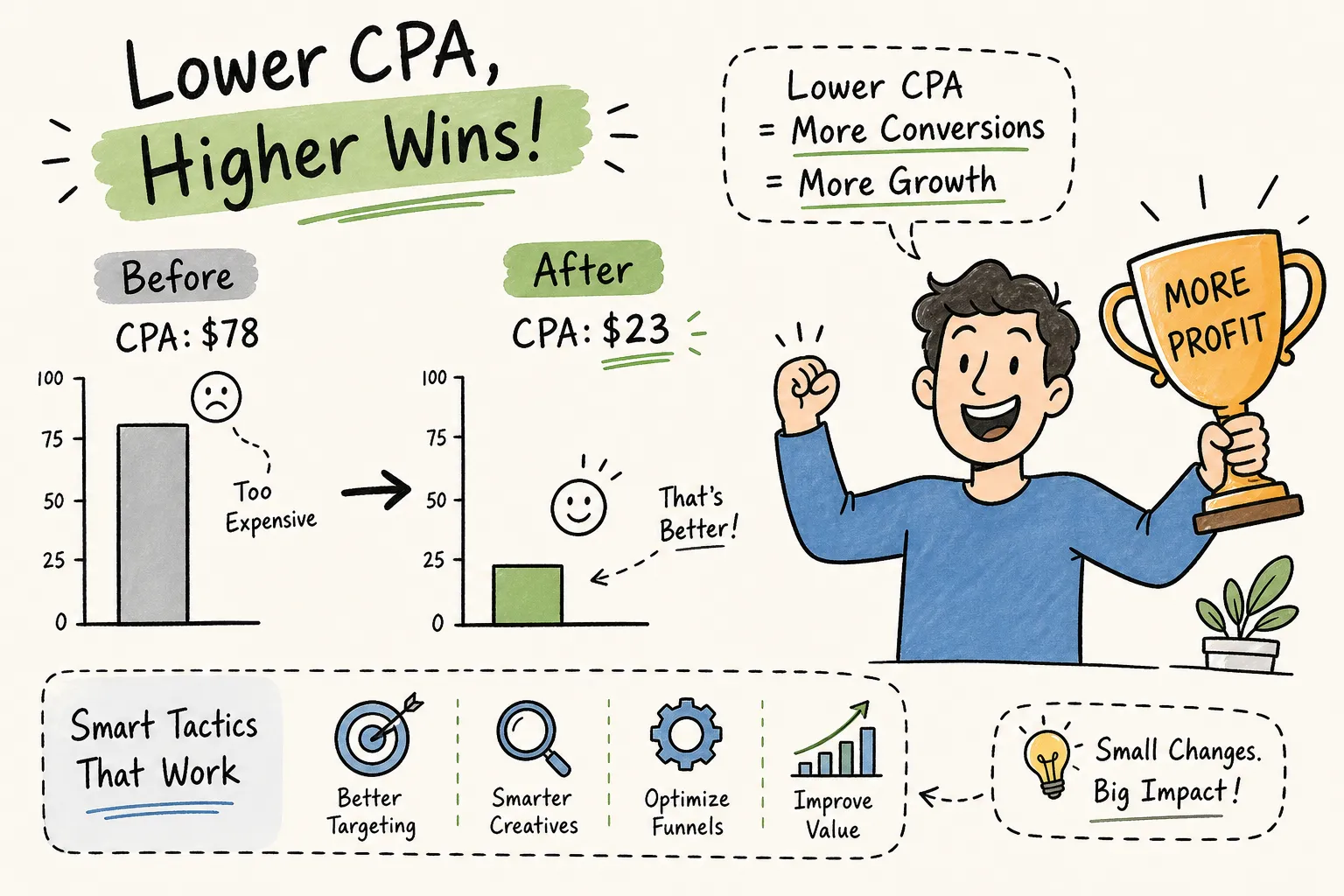
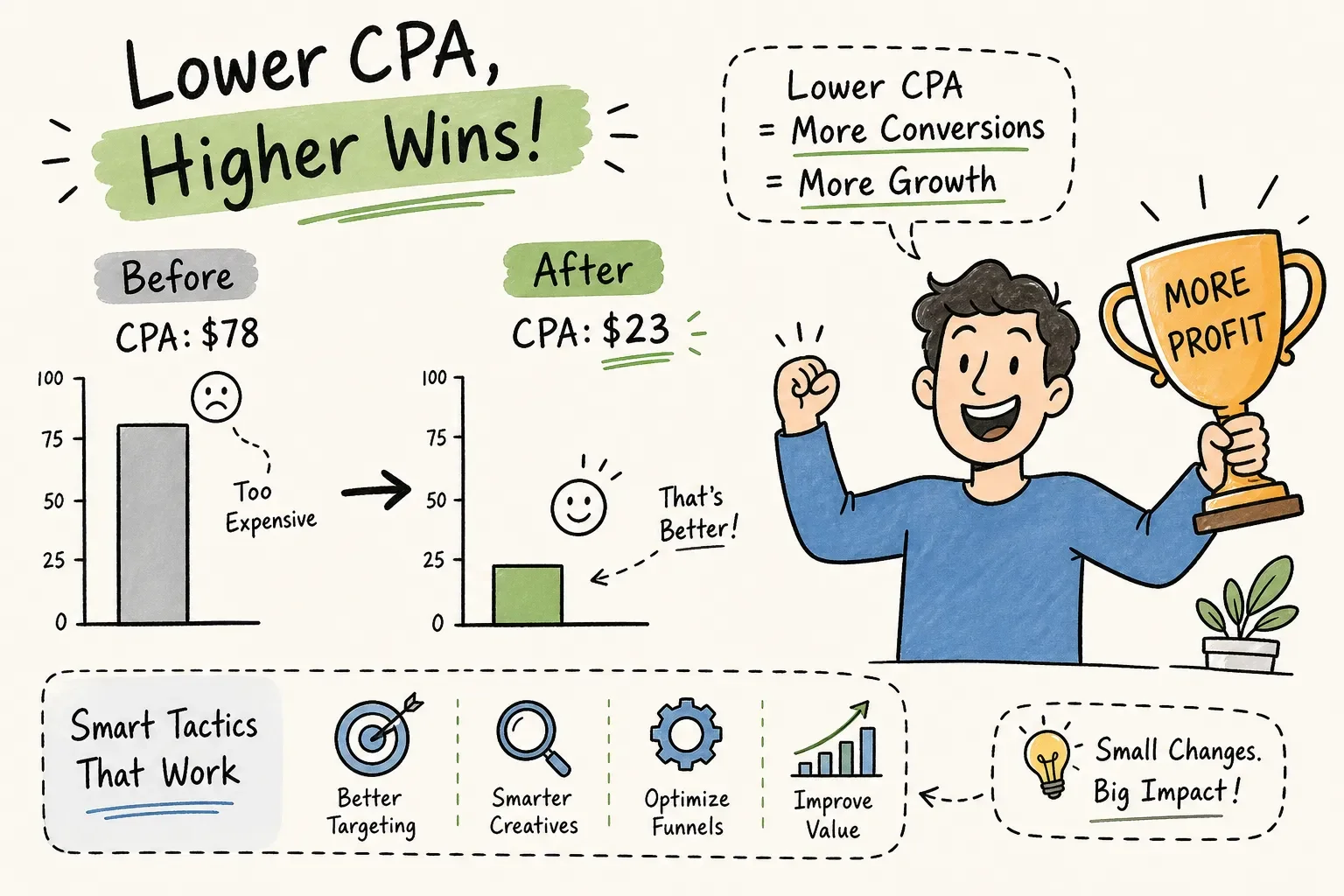
When CPA starts climbing, a common reaction is to cut budgets or swap out creatives. Both moves treat a symptom. The real problem is structural: targeting too broad, pricing models that charge for attention instead of intent, landing pages that bleed conversions, and CPA targets disconnected from what a customer is actually worth over time. You can't optimize your way out of a structural problem with tactical tweaks. To genuinely reduce cost per acquisition, you have to fix the system underneath the spend.
The most effective path to lower acquisition costs is a coordinated set of fixes, not a single lever. Sustainable CPA reduction happens when targeting, creative, landing page experience, and pricing model all work together. This article covers how to calculate and benchmark your CPA accurately, which levers move the needle fastest, and how to build an acquisition cost optimization framework anchored to LTV instead of arbitrary benchmarks.
Why your CPA is probably higher than it should be
The standard formula is straightforward: Total Campaign Cost divided by Number of Acquisitions. You can also express it as CPC divided by Conversion Rate for a quick funnel shortcut. Where most teams go wrong is in the numerator. Creative production, management fees, and non-converting traffic often get excluded, which makes CPA look better than it is and masks where the real waste is sitting. The distinction matters: campaign-level CPA and full customer acquisition cost (CAC) are different numbers, and conflating them produces decisions based on an incomplete picture. Full CAC should include all marketing and sales costs tied to winning that customer, not just the media line item.
The definition of "acquisition" also matters before any benchmarking is meaningful. A phone call, a form fill, and a closed sale are three different events with different cost structures. If your team mixes these definitions across reporting periods, your benchmarks become unreliable.
On the benchmark question: cross-industry PPC search averages around $59 per acquisition (WordStream, 2026). E-commerce brands typically target CPA under $30 for a $100 product; B2B software companies often accept $100 or more for a qualified lead. For insurance, average CAC runs between $1,280 and $1,487 depending on the product line. Healthcare paid CAC sits around $653. These numbers provide context, not targets. Your acceptable CPA depends entirely on your margin, churn rate, and what a customer is actually worth over their lifetime, not what competitors are paying.
How to reduce cost per acquisition through tighter targeting and media buying
Broad targeting is a CPA tax. When your ads reach people whose intent doesn't match your offer, you pay real dollars for traffic that was never going to convert. The fix starts with tightening geographic parameters, building out negative keyword lists from your search terms report, and layering demographic filters that reach buyers rather than browsers. For insurance campaigns specifically, state-level geo-targeting can affect both conversion rate and compliance in regulated product lines, making it a high-priority control rather than an optional refinement.
Direct platform control can speed up optimization cycles significantly. When a dedicated media buying team manages bids directly on the ad platform, decisions happen in real time rather than through a chain of approvals, and there's no third-party network markup built into the cost structure. That speed compounds: faster A/B testing on audiences and creatives means more optimization cycles per month, which drives faster CPA reduction over time. Ray Advertising's in-house media buying team operates on this model, and clients consistently see meaningful CPC improvements as a result.
Paying for impressions or clicks on unverified traffic is a structural problem, not a creative problem. To evaluate whether your current model qualifies as performance-based or impression-based, ask one question: do you pay when someone sees your ad, or only when they take a verified action? No amount of headline testing fixes a campaign that's buying the wrong audience at the wrong price. Performance-based pricing solves this at the model level, when you pay only for a qualified lead or inbound call, the cost-per-acquisition math changes fundamentally because non-qualified spend is filtered before the CPA calculation begins.
Quality Score and landing page fixes that lower ad cost per conversion
Quick fixes for Quality Score
Quality Score is one of the most underused levers in any conversion rate optimization (CRO) effort for paid search. WordStream's data shows CPA drops roughly 16% for each point above an average score of 5, and inflates by the same rate below it. Better Quality Score means Google treats your ad as more relevant, so you pay less per click for better placement. That CPC reduction flows directly into lower CPA before your conversion rate changes at all.
The fastest Quality Score improvements follow a clear sequence: pull your search terms report and add irrelevant queries as negatives. Then rewrite ad headlines to mirror the search query directly, consolidate ad groups into tightly themed clusters around single intent signals, and align your landing page headline and offer with the ad message. Page speed and mobile usability improvements support all three of Google's Quality Score components simultaneously, making them high-priority items for any account with below-average scores.
Landing page message match
On the landing page side, four conversion rate optimization tactics show up most consistently across funnel tests:
- Reducing form fields from seven to three has produced CPA drops of 40% or more in e-commerce and lead generation case studies (Unbounce, 2025)
- Switching to a simplified two-step form has driven CPA decreases in the range of 18% in B2B SaaS tests (HubSpot Research, 2025)
- Moving the primary CTA above the fold reduces drop-off at the critical decision moment
- Headline-to-ad message match is the single highest-leverage change most teams haven't fully executed
Pages that confirm to visitors that they're in the right place convert more. That's the principle behind every one of these changes. Shorter forms remove friction; message match reduces cognitive dissonance; clear CTAs eliminate ambiguity about the next step. If you're running A/B tests, single-variable tests on CTA copy, headline, and hero messaging will reach statistical significance fastest and typically resolve in under 30 days with adequate traffic volume.
Why retargeting is your fastest CPA reduction lever
Retargeting CPA typically runs 40 to 70% lower than cold prospecting CPA. The reason is straightforward: the audience has already expressed intent, needs fewer touchpoints, and converts at a higher rate. Retargeting conversion rates run 70 to 150% higher than cold traffic, and display retargeting CTR runs roughly 10 times higher than prospecting CTR (AdRoll Benchmark Report, 2025). The gap between a $125 prospecting CPA and a $50 retargeting CPA on social is a consistent industry pattern across verticals, not an isolated result.
Most teams over-invest in prospecting and under-fund retargeting, which raises their blended CPA unnecessarily. The more efficient allocation treats retargeting as a high-return budget line and uses prospecting to fill the top of the funnel at an accepted higher CPA, with your LTV:CPA ratio as the ceiling for what you're willing to spend. One practical caution: when retargeting CPA is dramatically lower than prospecting CPA, incrementality testing is worth running. Some of those conversions may have happened organically, meaning you're attributing natural demand to paid retargeting spend and overstating its contribution.
Set CPA targets using LTV and churn, not just ad spend
A flat-dollar CPA benchmark tells you almost nothing without LTV context. The calculation that actually drives decisions is: Average Revenue Per Customer multiplied by Gross Margin multiplied by Expected Customer Lifespan. The result defines your defensible CPA ceiling. The 3:1 LTV:CPA ratio is the most widely used rule of thumb, if LTV is $300, your CPA target ceiling is $100. CPA above 50% of CLTV compresses margins to the point where growth accelerates losses rather than profits.
Churn adjusts this ceiling directly. For subscription businesses, expected customer lifespan equals 1 divided by monthly churn rate. A business with 5% monthly churn has a 20-month customer lifespan; drop that to 3% monthly churn and the lifespan extends to 33 months, which raises LTV and creates more acquisition budget to work with. Improving retention is often the most cost-efficient way to unlock CPA headroom without touching media spend at all.
Use LTV:CAC as your channel prioritization metric, not CPA alone. A channel with a $90 CPA that delivers high-retention customers may outperform a channel with a $50 CPA that churns in three months. Scale channels where LTV:CAC exceeds 3:1, hold and optimize channels near the threshold, and cap or cut channels where CPA exceeds the churn-adjusted LTV ceiling. This requires channel-level LTV data, not just first-purchase revenue, which means your attribution setup needs to track downstream customer behavior, not just initial conversion events.
Performance-based pricing as a structural fix to reduce cost per acquisition
Shared leads are a quiet CPA inflator. When the same lead is resold to multiple competing advertisers, close rates fall and the cost to close rises, even if your creative and landing page are performing well. Exclusive lead models solve this at the source: one advertiser receives the lead, close rates improve, and CPA drops without any change to ad copy or page design.
Pay-per-call takes the performance model a step further. Inbound phone calls from verified intent traffic convert at rates that standard form fills rarely match, because the prospect has already decided to engage. CPM and broad CPC models charge for attention; performance-based models charge for outcomes. That structural difference realigns cost directly with acquisition, which is why the math often works even before any optimization is applied, provided strict qualification and fraud prevention are in place.
Ray Advertising's model operates on this principle: advertisers pay only for qualified inbound calls and verified leads, with built-in fraud detection and call quality monitoring. The CPA calculation starts from a cleaner baseline than standard media buys because non-qualified spend is eliminated upstream. Campaign onboarding in 48 hours and dedicated account management mean the optimization cycle starts faster, which matters when cutting CPA is urgent.
When evaluating any performance marketing partner, the questions worth asking are: Do leads come exclusively to you or get resold? What fraud prevention is in place? Is attribution real-time and transparent? Are reporting and payouts structured for full visibility? Ray Advertising is built around all four: a network of 4,000+ vetted affiliates, advanced fraud detection, real-time analytics with call recording, and weekly payouts with full campaign visibility. If your current acquisition costs are being driven by non-qualified traffic or shared leads, switching to a performance-based model is a structural fix, not an optimization tweak.
Putting it together
To reduce cost per acquisition at scale, you have to fix cost drivers at the structural level, not layer more creative tests on top of a broken system. The two moves with the highest leverage are almost always the same: tighten targeting and shift to a pricing model that charges for outcomes rather than attention. Quality Score improvement, landing page message match, and LTV-anchored CPA targets build on that foundation, they compound when the structure underneath is sound, and they don't when it isn't.
Teams that anchor CPA targets to LTV and churn make better channel decisions, scale without margin erosion, and stop optimizing channels that look cheap but deliver customers who don't stick around. That's the difference between a CPA that holds as you scale and one that quietly climbs as the funnel grows.
If you want a clear read on where your current acquisition spend is leaking, the Ray Advertising team runs a free campaign audit with real spend projections. The audit covers targeting structure, pricing model fit, and acquisition cost optimization opportunities specific to your campaigns. Reach out to start the conversation.
Recent Post
How to Scale Lead Generation Without Losing Qualit...
August 17, 2026
Improve Lead Generation Quality Without Losing Vol...
August 16, 2026
Reduce Cost Per Acquisition: 12 Tactics That Work...
August 14, 2026
Reduce Cost Per Acquisition: 12 Tactics That Work...
August 13, 2026
Car Insurance Leads for Agents: Best Sources and S...
August 12, 2026
What Are SR22 Insurance Leads and Why Are They So ...
August 11, 2026

Auto Insurance Pay Per Call: How It Works and Why ...
August 10, 2026

How to Buy Auto Insurance Leads That Actually Conv...
August 9, 2026
High Risk Auto Insurance Leads: How to Target and ...
August 8, 2026
Related resources
Explore the most relevant pages based on this article.
- Contact Ray Advertising — Ask about pricing, compliance, and launch timelines.
- Lead Generation — High-intent leads with delivery and quality controls.
- Pay Per Call — Qualified inbound calls with tracking and routing.
- Media Buying — Performance media with optimization and attribution.
- Affiliate Network — Vetted publishers and fraud protection.

FAQs
Quick answers related to this article.
We support lead generation, pay per call marketing, media buying, and affiliate network programs.
We use source attribution, quality metrics, and conversion reporting to optimize and scale profitable traffic.
Contact our team or sign up as an advertiser or publisher to begin onboarding.