



How to Buy Auto Insurance Leads That Actually Convert
By Ray Advertising · Published August 9, 2026
How to Buy Auto Insurance Leads That Actually Convert
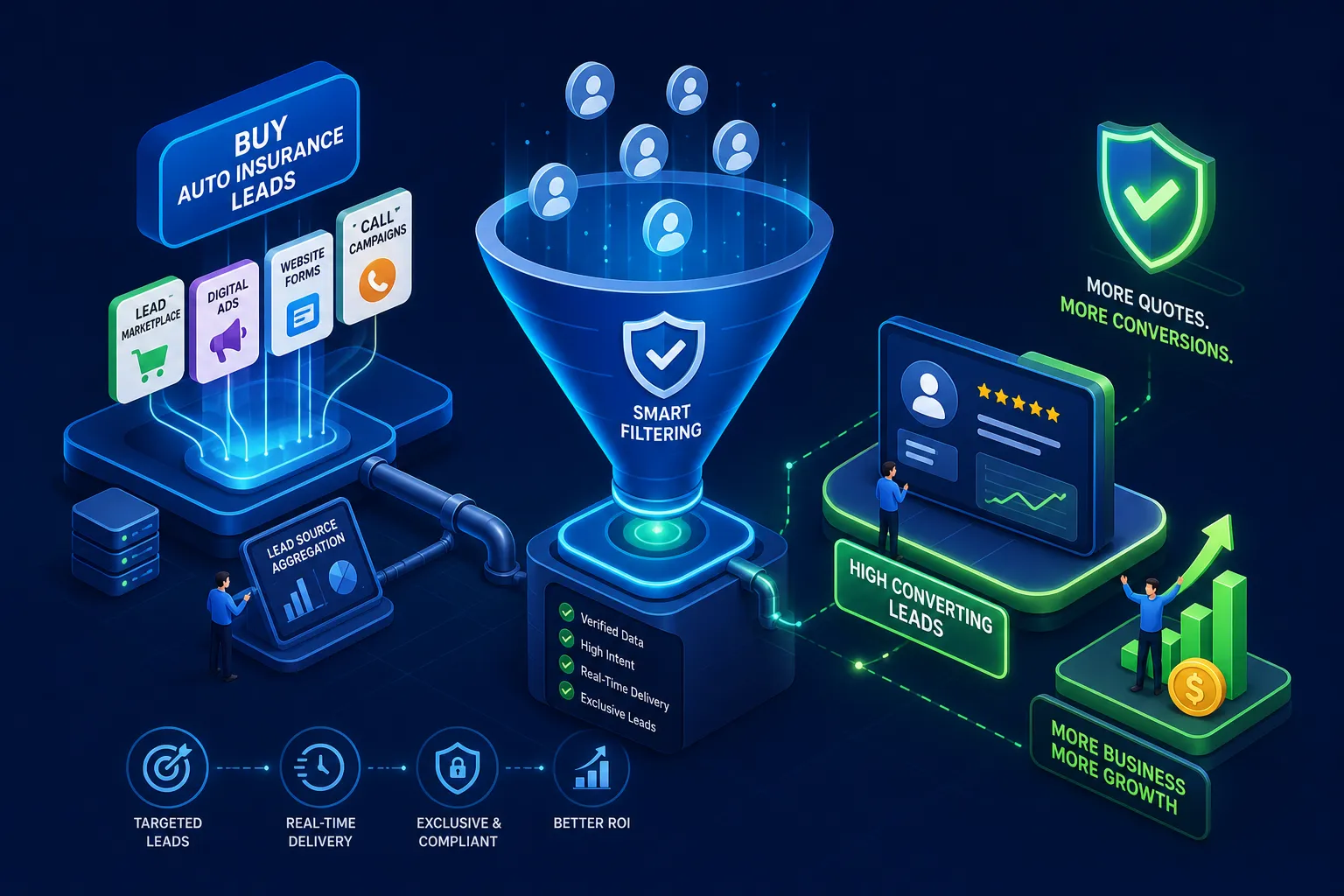
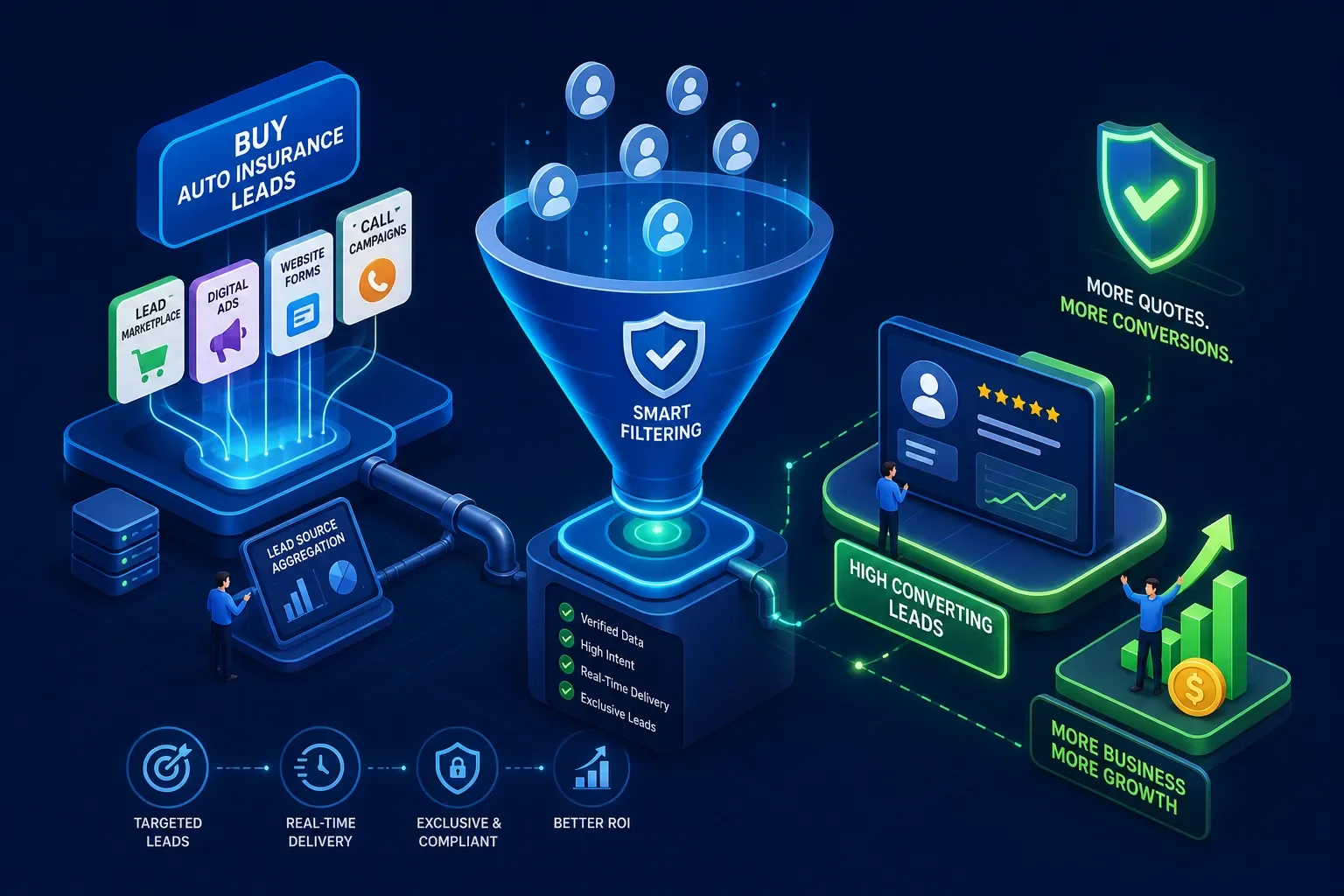
If you want to buy auto insurance leads that actually convert, the problem usually isn't effort. Most agents make the calls, work the pipeline, and follow up consistently. What kills performance is what they're starting with: leads that were never going to convert, delivered too slowly, from sources that prioritize volume over intent. At Ray Advertising, we've tracked and run more than 400 auto insurance lead campaigns since 2021. The difference between a 3% close rate and consistent double-digit conversion isn't a mystery. It comes down to a handful of decisions agents skip before they spend their first dollar.
This guide gives you a practical buyer's framework. By the time you finish reading, you'll know how to evaluate any lead provider on the criteria that actually predict conversion, run the ROI math before you commit to a volume, and build a lead-buying operation that scales without bleeding your acquisition cost dry.
What Separates a High-Quality Auto Insurance Lead from a Dead End
Not every form fill is a lead. A consumer who entered a name and zip code to grab a comparison result is fundamentally different from one who answered qualifying questions, confirmed current coverage status, and submitted with a genuine intent to switch or purchase. Understanding that gap is the first filter you should apply to any vendor conversation.
What "Pre-Qualified" Actually Means in This Market
A genuinely pre-qualified auto insurance lead shows clear purchase signals: recent quote-shopping behavior, an upcoming renewal or policy lapse, verified contact information, and a stated coverage need that matches what you sell. Many vendors use the word "pre-qualified" loosely, so press them. Ask specifically what qualifying questions their forms include, whether consumers confirm intent to receive quotes, and what validation happens between form submission and delivery to your inbox. Tools like TrustedForm and Jornaya are industry-standard for consent documentation, if a vendor can't describe their consent capture process, that's a red flag.
The strongest leads in any auto insurance campaign come from consumers who are actively comparing options, not passively browsing. Traffic source matters here more than most agents realize. Leads generated from organic search or direct comparison site activity consistently show stronger purchase intent than co-registration traffic or incentivized lead forms, where the consumer may have submitted to claim something unrelated to insurance.
How Intent Verification Works in Practice
Reputable vendors layer multiple validation checks before a lead moves to delivery. Standard practice in 2026 includes real-time phone verification, duplicate suppression against their own database, TCPA-compliant consent documentation, and behavioral signals that distinguish genuine shoppers from bot submissions. The consent record should capture a timestamp, IP address, and the exact form the consumer completed.
Before signing with any provider, ask this one question directly: "How is this lead sourced, and what specific checks happen between the consumer's submission and delivery to my CRM?" Vague answers, or answers that rely entirely on the replacement policy as a backstop, signal a quality problem before you've bought a single lead.
How to Buy Auto Insurance Leads: Exclusive vs. Shared
This is the decision with the biggest impact on your cost per bound policy, and it's also the one most commonly made on the wrong metric: price per lead.
The Conversion Rate and CPA Comparison
Current 2026 benchmarks place exclusive auto insurance leads at a 10% to 25% conversion rate. Shared leads typically convert between 2% and 8%. At first glance, shared leads look attractive because the per-lead price is lower, often $7 to $15 versus $25 to $75 for exclusive inventory. Run the CPA math, though, and the gap narrows fast.
A $30 exclusive lead closing at 15% produces a cost per bound policy of roughly $200. A $10 shared lead closing at 5% lands at that same $200. The critical difference is that shared lead performance degrades as competition increases. You are not the only agent calling that number. When three or four agents are dialing the same prospect within minutes of each other, your effective close rate drops and agent time cost rises. The published per-lead price on shared inventory almost never reflects the true cost per acquisition once you factor in lower close rates and the time your sales team spends on low-probability contacts.
When Shared Leads Can Still Work
Shared leads aren't automatically the wrong choice. An agency with a high-volume operation, fast-response infrastructure, and a polished quote process can work shared inventory profitably if contact speed is near-instant and the sales script converts efficiently. For most independent agents and smaller carriers, though, that infrastructure doesn't exist. Exclusive leads remove the contact-race dynamic entirely and put the conversion outcome back where it belongs: your process, not your speed relative to three other agents.
Buy Auto Insurance Leads at the Right Price: Pricing Models and Break-Even Math
Two primary pricing structures dominate this market. Understanding both, and running your own numbers before talking to a vendor, puts you in a materially stronger position.
The Pricing Models You'll Encounter
Pay-per-lead charges a flat fee for each delivered contact, typically $15 to $75 or more for exclusive auto leads depending on state, coverage type, vehicle attributes, and credit tier filters. Pay-per-call shifts the model: instead of a form-fill contact, you're paying for a qualified inbound call from a consumer who is actively shopping, and pricing is usually quote-based rather than publicly posted.
Filters directly affect price. Narrower criteria, a specific state, clean driving record, homeowner status, a particular vehicle year range, produce tighter lead pools that cost more per unit but match your underwriting appetite much better. Watch for these pricing traps:
- Vendors who don't publish a clear replacement policy
- Vendors who sell "semi-exclusive" leads without defining what that means
- Vendors who require large monthly minimums before you've validated their lead quality on a trial batch
The Break-Even Formula Every Agent Should Run First
The math is straightforward. Divide your lead cost by your expected close rate to get cost per bound policy. For example: at $40 per lead with a 15% close rate, your CPA lands at roughly $267. CPA = $40 ÷ 0.15 = ~$267. If that policy generates $1,200 in first-year premium at a 40% margin, the unit economics work clearly in your favor. Drop the close rate to 8% and the same leads put you at $500 per bind, a completely different picture.
Don't project your expected close rate from industry benchmarks when starting with a new vendor. Your actual close rate depends on your follow-up speed, your quote process, and how well the lead criteria match your book. Start with a small trial batch, measure your real numbers, and then scale from a baseline you actually own.
Why Lead Delivery Speed and CRM Integration Directly Affect Your Close Rate
Lead quality gets you to the conversation. Delivery speed determines whether you ever have it.
The Speed-to-Contact Window
The data on this point is consistent across credible industry research: leads contacted within five minutes of submission convert dramatically better than leads reached 30 minutes or more later. A widely cited MIT lead-response study found that contacting a lead within five minutes made qualification roughly 21 times more likely than waiting 30 minutes, and insurance-specific performance data echoes that pattern. After 24 hours, close rates on internet-submitted leads routinely fall below 3%.
Real-time delivery via API or webhook is not optional if you're serious about conversion. A vendor who delivers leads via email batch or manual export puts you behind before you pick up the phone. At Ray Advertising, our delivery standard targets a 5-minute window from consumer submission to CRM notification, hold every provider you evaluate to that same benchmark.
CRM Integration: What to Require from Any Vendor
The four most widely supported CRMs across established lead vendors are Salesforce, HubSpot, Pipedrive, and Zoho. Before committing to any provider, verify that your specific CRM is supported and confirm the delivery method. API and webhook delivery are the current standard for real-time lead creation. Native CRM connectors work well when properly configured. Email delivery is still offered by some smaller vendors, but the latency it introduces will cost you conversions regardless of how strong the lead itself is.
If a vendor can't push leads directly into your CRM in real time, that's an operational bottleneck that compounds every day you run volume through it. Get the integration confirmed in writing before you sign anything.
How to Evaluate Auto Insurance Lead Providers Before You Commit a Dollar
The right vetting process protects your budget and surfaces the quality differences that pricing alone doesn't reveal.
The Questions That Reveal a Provider's Actual Quality
Ask every vendor the same set of questions before buying. How are leads sourced? Are they exclusive or resold after a defined period? What is the average delivery time from submission to your system? What filters are available and how granular do they get? What is the replacement policy for invalid leads, and what documentation is required to file a return? A provider with genuine quality controls answers these questions directly. Vague sourcing answers typically mean co-registration or low-intent traffic is in the mix.
One signal that separates quality vendors from commodity ones: willingness to share actual performance data. Close rate benchmarks, delivery speed metrics, and CPA data by vertical aren't things low-quality providers can publish honestly. A vendor who puts real numbers on the table is a materially different caliber of partner. When you're shopping insurance agent leads for sale, that transparency is non-negotiable.
Quality Guarantees and Replacement Policies: What's Standard
Reputable providers replace leads that are clearly invalid: disconnected numbers, duplicates, leads outside agreed criteria, or contacts who never requested a quote. Get the replacement policy in writing and confirm the exact qualifying reasons, the remedy (refund versus account credit versus replacement), the filing deadline, and any caps on returns per period. If the policy is described as "at our discretion," treat that as a red flag before your first dollar is spent.
What Ray Advertising Offers Agents Buying Exclusive Auto Insurance Leads
Ray Advertising delivers 100% exclusive leads with no reselling. Every lead goes through intent verification, duplicate suppression, and contact validation before it reaches your CRM, and delivery targets a 5-minute window from submission to notification. Custom filters let you target by state, vehicle type, coverage criteria, and geographic footprint, so the leads you receive match your actual book of business rather than a generic auto insurance audience.
Campaign onboarding typically takes 48 hours or less. You work with a dedicated account manager rather than a self-serve portal, receive leads via real-time CRM delivery through API or webhook, and have full visibility into performance data from day one. When you're comparing providers, use those benchmarks as your standard: exclusivity, delivery speed, transparent performance data, and a replacement policy in writing. A vendor who can't match that combination is a gap you're accepting every time you purchase auto leads from them.
Building a Lead-Buying Strategy That Scales Without Losing Quality
Evaluation gets you to the right vendor. Execution determines whether that relationship actually produces profitable growth.
Start with a Trial Batch, Not a Commitment
Negotiate a small trial run of 25 to 50 leads before committing to monthly volume. This gives you a real baseline close rate using your actual sales process rather than projections from industry averages. Track three metrics during the trial: contact rate (how many leads pick up), quote rate (how many get to a full quote), and bind rate. Those three numbers tell you exactly where any conversion breakdown is happening, whether it's lead quality, follow-up speed, or something in your quoting process.
Setting Filters That Match Your Book of Business
Broader filters produce more volume at a lower cost per lead, but they also produce leads that don't match your underwriting appetite or geographic licensing. Tighter filters reduce lead volume and raise per-lead cost, but the leads that do come through are far more likely to fit what you actually sell. Start by identifying your three most profitable existing customer profiles and build your filter criteria around those parameters: state, vehicle age, homeownership status, and coverage type are the four most common levers.
When you buy auto insurance leads, the goal isn't to find the cheapest source, it's to find the provider with the infrastructure, exclusivity, and delivery speed to make your sales process perform at full capacity. A lead that doesn't convert isn't cheap. Factor in agent time, follow-up cost, and displaced opportunity, and a bad $10 lead can cost more than a well-sourced $50 one.
The Bottom Line on Buying Auto Insurance Leads
Four factors determine whether purchased leads produce profit or drain your budget: exclusivity over raw per-lead price, real-time delivery over batch processing, intent-verified sourcing over volume promises, and a vendor willing to stand behind their quality with transparent performance data and a written replacement policy. Get those four right and the ROI math works in your favor at scale.
The goal isn't to buy the most leads. It's to build a predictable acquisition cost that grows your book of business profitably, month over month, without the conversion unpredictability that comes from cutting corners on quality or delivery speed.
When you're ready to buy auto insurance leads and want to evaluate providers against these benchmarks, start with what Ray Advertising offers for your specific market. Reach out to our team to see what an exclusive auto insurance lead program looks like for your state, your filters, and your production goals. The fastest path to real conversion data is getting live, verified leads into your pipeline and measuring what actually happens, not projecting from someone else's averages.
Recent Post
How to Scale Lead Generation Without Losing Qualit...
August 17, 2026
Improve Lead Generation Quality Without Losing Vol...
August 16, 2026
Reduce Cost Per Acquisition: 12 Tactics That Work...
August 14, 2026
Reduce Cost Per Acquisition: 12 Tactics That Work...
August 13, 2026
Car Insurance Leads for Agents: Best Sources and S...
August 12, 2026
What Are SR22 Insurance Leads and Why Are They So ...
August 11, 2026
Auto Insurance Pay Per Call: How It Works and Why ...
August 10, 2026
How to Buy Auto Insurance Leads That Actually Conv...
August 9, 2026
High Risk Auto Insurance Leads: How to Target and ...
August 8, 2026
Related resources
Explore the most relevant pages based on this article.
- Contact Ray Advertising — Ask about pricing, compliance, and launch timelines.
- Lead Generation — High-intent leads with delivery and quality controls.
- Pay Per Call — Qualified inbound calls with tracking and routing.
- Media Buying — Performance media with optimization and attribution.
- Affiliate Network — Vetted publishers and fraud protection.

FAQs
Quick answers related to this article.
We support lead generation, pay per call marketing, media buying, and affiliate network programs.
We use source attribution, quality metrics, and conversion reporting to optimize and scale profitable traffic.
Contact our team or sign up as an advertiser or publisher to begin onboarding.