



Car Insurance Leads for Agents: Best Sources and Strategies in 2026
By Ray Advertising · Published August 12, 2026
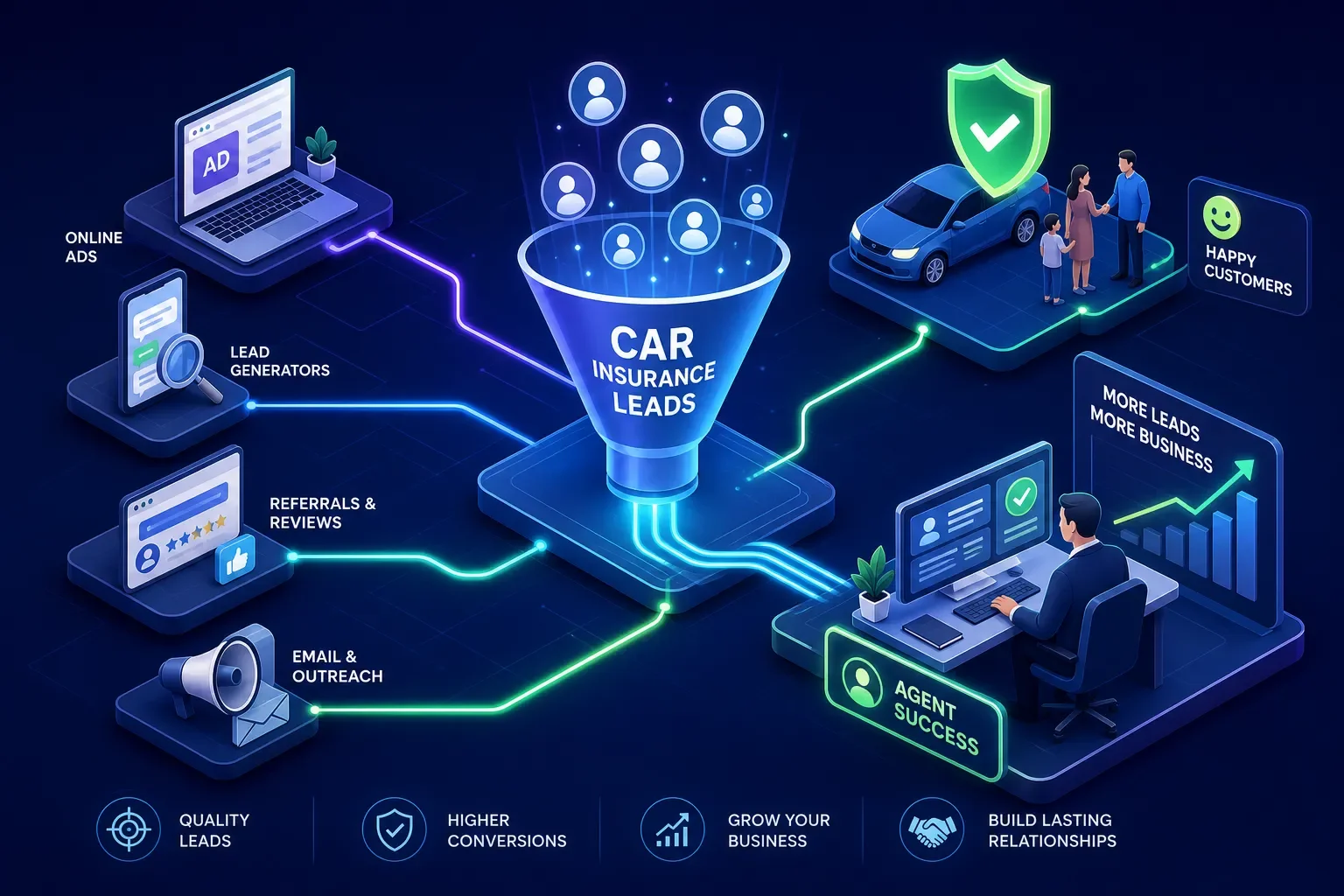
Car Insurance Leads for Agents: Best Sources and Strategies in 2026
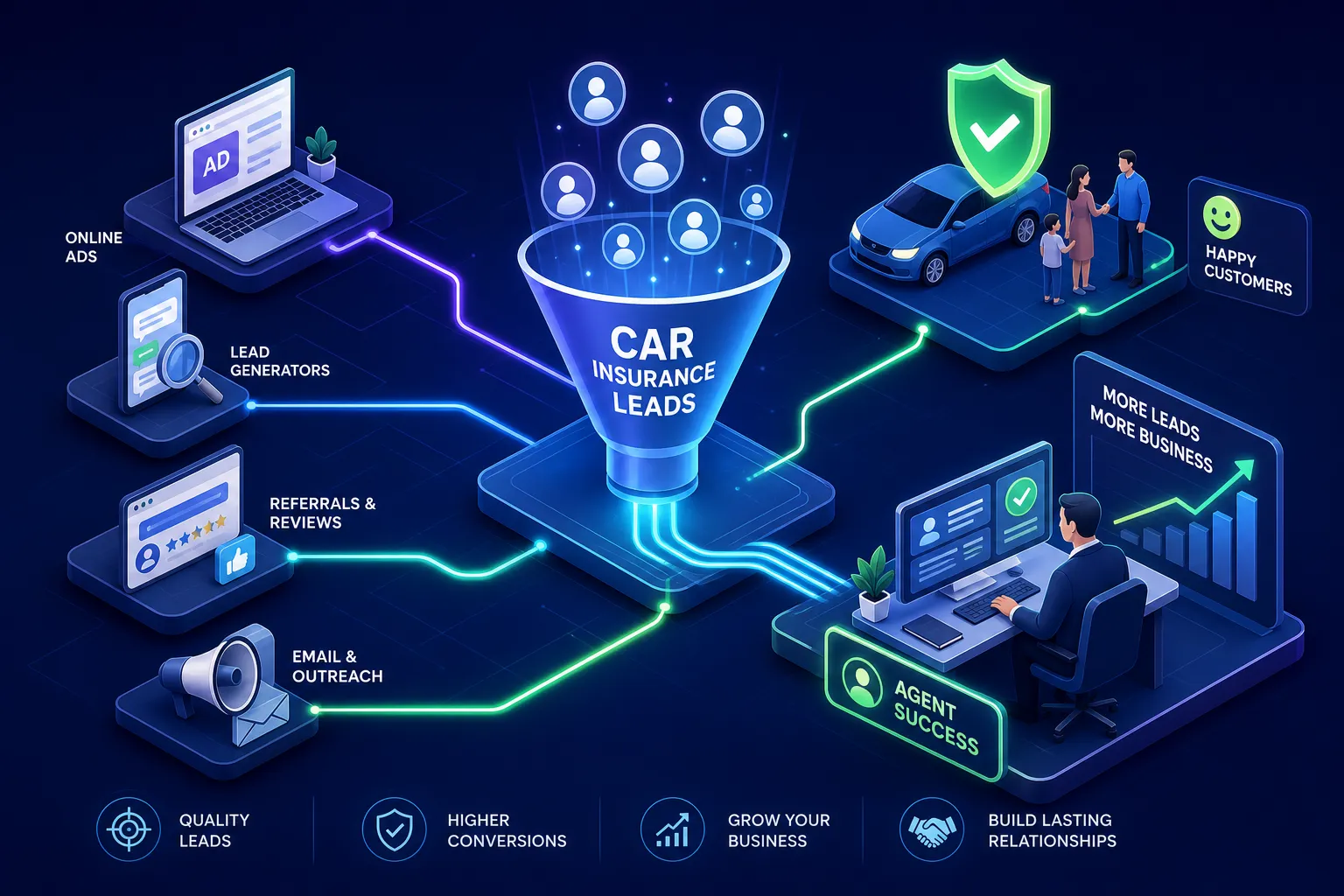
Car insurance leads for agents have never been harder to compete for. Independent agents are going up against billion-dollar carriers for the same auto insurance prospects, but doing it with a fraction of the budget and without the media buying infrastructure that actually moves the needle. Many independent agents lack the affiliate relationships, publisher scale, and fraud detection infrastructure that carriers have built over years. The gap isn't just about money, it's about access: the right channels, lead sources, and data to make buying decisions with confidence instead of guessing.
This article breaks down every major source for car insurance leads for agents in 2026, how to evaluate lead quality before you spend anything, the cost-per-sale math that determines whether a channel is actually profitable, and a follow-up playbook built around what closes. Companies like Ray Advertising have started opening the same affiliate network and media buying infrastructure that carriers have used for years, making it accessible to independent agents. That shift is worth understanding before you spend another dollar on shared web leads.
Where independent agents actually source car insurance leads in 2026
Most agents draw from one of three channels: buying leads from vendors, running their own paid campaigns, or accessing affiliate and call networks. Each has a different cost structure, quality profile, and learning curve. Understanding how they work is the prerequisite to knowing which one fits your budget and goals.
Car insurance leads for agents: buying from lead vendors vs. building your own pipeline
The major lead vendors in 2026 include EverQuote, NextGen Leads, SmartFinancial, QuoteWizard, and InsuranceLeads.com, among others. Most operate on a cost-per-lead model where you pay for each record delivered, shared leads sold to multiple agents simultaneously, or exclusive leads sold only to you. Shared leads are cheaper, typically $15 to $40 per lead, but you're dialing against three to five other agents who received the same contact at the same time. Exclusive leads run $40 to $100 or more, but you're the only agent in the conversation. Many agents start with shared leads and migrate toward exclusive inventory once they run the cost-per-sale math and realize cheaper isn't cheaper at all.
Running your own paid search and social campaigns
Google Ads and Meta give agents direct control over targeting and budget, with no vendor margin sitting between you and the prospect. When campaigns are properly optimized, they produce real-time insurance leads with strong purchase intent, the consumer was actively searching for a quote. The tradeoff is that effective campaigns require meaningful daily spend and real media buying expertise. Most independent agents who try to run their own paid search end up paying retail CPCs while making targeting decisions that bleed budget without producing the volume needed to optimize against.
Affiliate networks and inbound call campaigns
In the affiliate model, publishers drive traffic and generate leads or calls, and agents pay per qualified lead or per inbound call. Inbound phone calls carry far higher intent than web form submissions because the consumer picked up the phone, signaling genuine readiness to talk rather than passive curiosity. Across most affiliate networks, pay-per-call auto insurance leads close at 15 to 30 percent, compared to 5 to 15 percent for web form leads, a difference that changes the cost-per-sale math significantly. The catch is that quality affiliate inventory has historically required carrier-level volume commitments and campaign infrastructure, putting it out of reach for most independent agents working without a dedicated performance marketing team.
How to evaluate lead quality before you spend a dollar
Not all leads are equal, and CPL is the least useful number for comparing sources. Before you commit budget to any vendor or channel, you need a framework for evaluating four things: lead age, source quality, exclusivity, and what prequalification data comes with each record.
Lead age, source, and exclusivity as conversion predictors
Intent decays fast. A lead older than 24 hours becomes significantly harder to close, the prospect has likely already spoken with several agents or moved on entirely. For best results, contact should happen within minutes of delivery, not hours. Source quality matters because different channels produce leads with different intent signals; an organic search lead and a social media click lead are not equivalent even if both arrive as web forms. Exclusivity removes the speed-to-contact pressure that kills conversion on shared leads: when a prospect is simultaneously fielding calls from four other agents, the conversation starts in a commodity negotiation rather than a consultative one. Shared auto leads convert at roughly 5 to 12 percent; exclusive auto leads convert at 10 to 25 percent or higher with disciplined follow-up.
Prequalification fields that separate good leads from junk
Better prequalification data, including vehicle type, current coverage status, zip code, and budget range, improves downstream conversion by filtering out low-fit prospects before the first dial. The tradeoff is real: longer forms reduce total lead volume, so the question is whether the conversion lift from better-qualified records offsets the lower quantity. The answer depends on your close rate and cost-per-sale targets, which is another reason to run the math before scaling any single source.
TCPA compliance: what purchased leads actually require from you
Every purchased lead comes with a compliance obligation. There are four requirements you need to handle before any outreach begins:
- Obtain prior express written consent that names your company specifically, not just a blanket "partners may contact you" checkbox on a vendor's form.
- Scrub against the National DNC list and applicable state DNC lists before contact.
- Restrict calls to 8 a.m. through 9 p.m. in the consumer's local time zone.
- Verify the actual consent language on any vendor's lead form and get compliance representations in writing before buying at volume.
If a dispute arises, the burden of proving valid consent falls on you, not the vendor.
Pricing benchmarks and the ROI math every agent should run first
CPL is a starting point, not a decision-making metric. The number that actually tells you whether a lead source works is cost per sale, what you're actually paying for every closed policy rather than every record delivered.
What auto leads actually cost in 2026
Shared web leads from major vendors run approximately $15 to $40 per lead. Exclusive auto leads range from $40 to $100 per lead, and higher-intent exclusive leads, especially inbound calls, can reach $100 to $200 depending on filters and geography. Price alone tells you almost nothing without conversion rate data layered on top, which is why agents who shop purely on CPL consistently overpay when you look at their actual acquisition cost per policy.
Calculating cost per sale, not cost per lead
Here's the calculation that matters. A $40 shared lead at a 10 percent close rate costs $400 per policy sold. A $120 exclusive lead at a 35 percent close rate costs approximately $343 per policy sold. The exclusive lead costs three times as much per record and comes out cheaper per sale. Run this calculation with your own close rate data before defaulting to the cheapest shared leads on the assumption that lower CPL equals better ROI. It almost never does.
How car insurance leads for agents convert, benchmarks by channel
Affiliate-driven inbound calls typically show the strongest conversion of any lead type because the prospect is already on the phone and actively shopping. Self-generated paid search leads sit between shared vendor leads and exclusive inventory, depending on campaign quality. The fastest path to meaningful ROI data is testing two or three sources simultaneously with a consistent follow-up cadence, so you're measuring conversion performance on equal terms across channels.
How Ray Advertising gives independent agents carrier-level infrastructure
The structural disadvantage independent agents face isn't a matter of effort. It's access. Carriers have affiliate relationships, media buying scale, and fraud detection infrastructure that took years and significant capital to build. Ray Advertising makes that infrastructure available to independent agents without requiring them to build it from scratch.
The affiliate network most independent agents can't access on their own
Ray Advertising's network of vetted publishers generates high-intent auto insurance traffic, the kind of inventory that carriers have sourced for years. Independent agents typically can't access this inventory directly because affiliate networks require volume commitments, campaign infrastructure to manage publisher relationships, fraud screening, and real-time routing capabilities. Ray Advertising removes that barrier by letting agents plug into an already-optimized network rather than negotiating each publisher relationship individually and building quality controls from zero.
In-house media buying that changes the cost equation
Ray Advertising's in-house media buying team operates across major ad platforms and consistently achieves lower CPCs than agents running campaigns independently, based on campaigns managed through Ray Advertising's platform. Independent agents paying retail CPCs while carriers negotiate bulk rates represents one of the biggest structural cost disadvantages in the market. Managed media buying closes that gap without requiring an agent to hire a full-time paid media specialist or spend months learning platform mechanics through expensive trial and error.
Fast onboarding, real-time routing, and built-in fraud protection
According to Ray Advertising, campaign onboarding takes as little as 48 hours, with a dedicated account manager, geo-targeting and scheduling controls, and real-time call routing built in from day one. Ray Advertising reports a 95-plus percent call quality score backed by fraud detection technology that screens out invalid traffic before it reaches the agent's pipeline. For independent agents, this means no months-long ramp, no paying for bad traffic, and no manual quality auditing that pulls time away from actually selling policies.
The follow-up playbook that turns purchased leads into closed policies
The best lead source in the market won't close at a meaningful rate without a structured follow-up process. Speed and consistency are the two variables that separate agents who close at 25 percent from agents closing at 8 percent on the same lead source.
Speed-to-lead: the metric that matters more than your script
In practice, contacting a purchased lead within five to ten minutes of delivery outperforms any follow-up tactic applied after an hour. A prospect who just completed a quote form is still in active research mode; the agent who calls first frames the entire conversation before competitors have a chance to engage. Send an SMS within the first minute ("Got your request, calling you now") as a low-friction first touch that sets you apart before the phone even rings. That brief text serves as a trust signal and distinguishes you from agents who cold-call out of context.
The first-week multi-touch cadence
Industry contact-rate data consistently shows the first week produces approximately 80 percent of appointments, so the cadence here is non-negotiable. Day one includes a call, voicemail, email, and text. Days two through five involve morning and evening call attempts with personalized email follow-ups that add something new each time: a relevant coverage detail, a rate comparison, or a short video introduction rather than a repeated ask. Week two drops to two calls and one email every few days, transitioning from dense outreach to a nurture rhythm. The goal in week one is contact, not close, every touchpoint builds the familiarity and trust that makes the closing conversation easier when it happens.
Timing, scripting, and long-term nurture
Afternoon calls between 4 and 6 p.m. connect better than morning attempts, and Wednesday and Thursday outperform Monday and Friday consistently. Email performs best when personalized and sent Tuesday through Thursday between 9 and 11 a.m. in the recipient's local time zone. For leads that don't convert in week one, a monthly drip sequence keeps you top of mind until the prospect is ready or explicitly opts out. TCPA opt-out requests must be honored immediately and documented; an opt-out that isn't logged creates compliance exposure regardless of how strong the lead looked at acquisition.
The four decisions that determine whether auto insurance leads pay off
Agents who close at consistently high rates aren't doing anything exotic. They're working better leads with a faster, more structured response. Four decisions drive that outcome:
- Choosing the right sourcing channel for your budget and volume goals
- Evaluating lead quality before buying rather than after
- Running cost-per-sale math instead of judging by CPL alone
- Executing a disciplined multi-touch follow-up within the first week of lead delivery
For independent agents who want to skip the trial-and-error of building affiliate relationships and media buying operations from scratch, Ray Advertising provides a direct path to the infrastructure that carriers already use. That access is no longer reserved for carriers with eight-figure media budgets, and that's a meaningful shift for any independent agent serious about insurance lead generation.
If you're ready to stop buying shared car insurance leads for agents on hope and start acquiring high-intent prospects with measurable ROI, contact Ray Advertising to get your campaign live within two business days.
Recent Post
How to Scale Lead Generation Without Losing Qualit...
August 17, 2026
Improve Lead Generation Quality Without Losing Vol...
August 16, 2026
Reduce Cost Per Acquisition: 12 Tactics That Work...
August 14, 2026
Reduce Cost Per Acquisition: 12 Tactics That Work...
August 13, 2026
Car Insurance Leads for Agents: Best Sources and S...
August 12, 2026
What Are SR22 Insurance Leads and Why Are They So ...
August 11, 2026
Auto Insurance Pay Per Call: How It Works and Why ...
August 10, 2026
How to Buy Auto Insurance Leads That Actually Conv...
August 9, 2026
High Risk Auto Insurance Leads: How to Target and ...
August 8, 2026
Related resources
Explore the most relevant pages based on this article.
- Contact Ray Advertising — Ask about pricing, compliance, and launch timelines.
- Lead Generation — High-intent leads with delivery and quality controls.
- Pay Per Call — Qualified inbound calls with tracking and routing.
- Media Buying — Performance media with optimization and attribution.
- Affiliate Network — Vetted publishers and fraud protection.

FAQs
Quick answers related to this article.
We support lead generation, pay per call marketing, media buying, and affiliate network programs.
We use source attribution, quality metrics, and conversion reporting to optimize and scale profitable traffic.
Contact our team or sign up as an advertiser or publisher to begin onboarding.